Tuesday, July 11, 2017

Education in Finland

Education in Finland

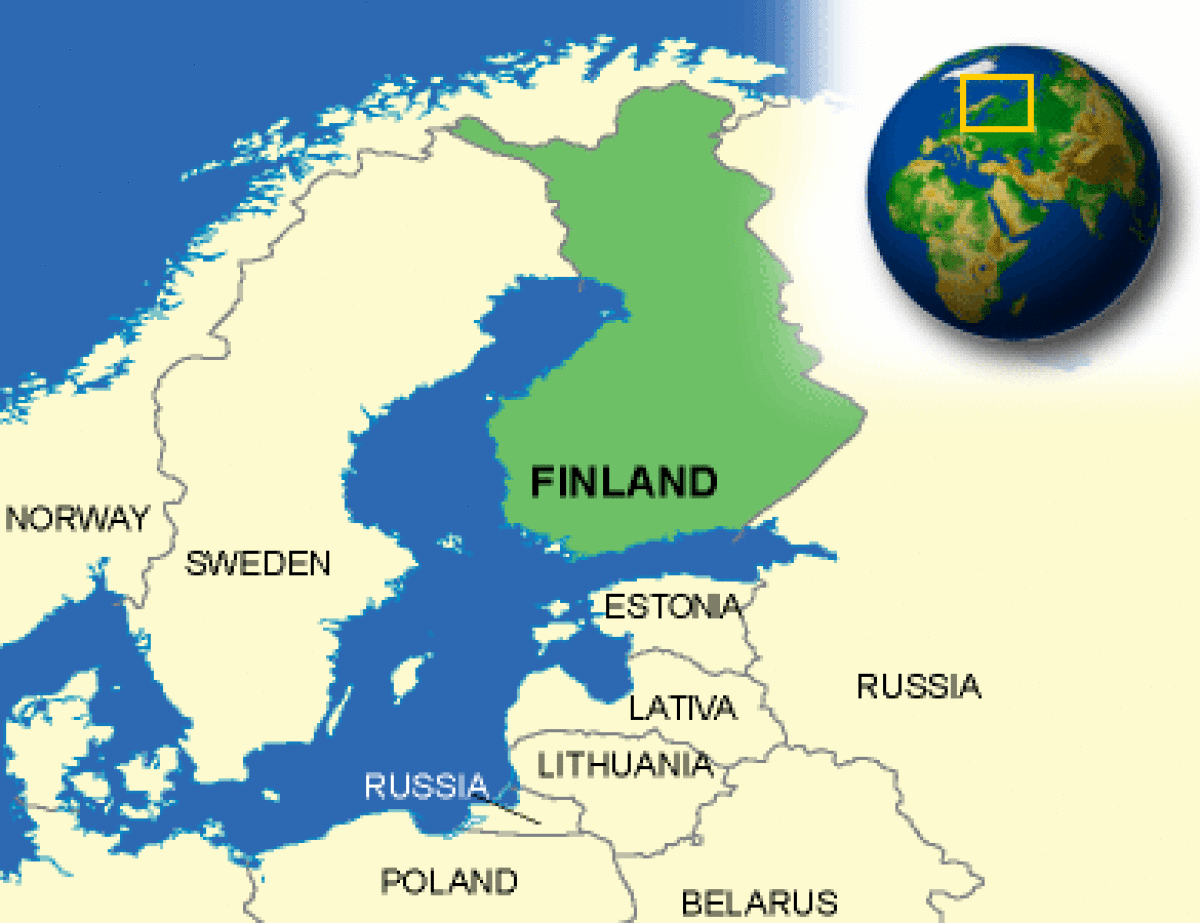
Geographical details of Finland


Finlandcountry located in northern Europe. Finland is one of the world’s most northern and geographically remote countries and is subject to a severe climate. Nearly two-thirds of Finland is blanketed by thick woodlands, making it the most densely forested country in Europe. Finland also forms a symbolic northern border between western and Eastern Europe: dense wilderness and Russia to the east, the Gulf of Bothnia and Sweden to the west.
Image result for geographical details of finland


Education system in Finland


Some important facts on Education system of Finland

  • ·    “Education is free of cost and equal to all students” this is the basic principle of education system of Finland.
  • ·         Children go to the school at the age of 7 years for their basic education.
  • ·         99 % students study in government schools.
  • ·         There are no space for private schools and coaching also.
  • ·         Mid – day meal is provided to the all students.
  • ·         Education system and the quality of education of schools are same whether those are situated in village or in city.
  • ·         A class teacher remains the same from first class to sixth class .The reason behind it is that a class teacher try to maintain a relationship with all students .
  • ·         English language is taught using musical instruments and playing English songs so that it can be easy to learn .
  • ·         Most important part of education system of Finland is that the special attention is paid to those students who are weak in studies. It is the responsibility of school to help those students in those subjects in which they are weak. If they do not recover special extra classes are given to them and teachers from outside are also called so that they can help them to grow their level up.
  • ·         Many foreign languages are taught to the students during the period of upper secondary school.
  • ·         Different kinds of games are played by students and these help them to create better understanding .They interact with all students, trust them, learn team building and social qualities.
  • ·         No examination is conducted from 1st std. to 12th std. They go to the next class on the basis of internal assessment.
  • ·         Education system of Finland is completely Governalized.


Education in Finland in nutshell, here is Pdf link of this article.


another superb clarification of Education system in Finland. 

reasons for behind the success of Finland education system.


Why Finland famous for education???


Pasi Sahlberg is Finnish educator, author and scholar. He is experienced in classroom teaching, training teachers and leaders, coaching schools and advising education policy-makers around the world. Pasi is an international speaker and author who has given more than 400 keynote speeches and published over 100 articles, chapters and books on education.

When he questioned about success of education in Finland.


he speaks on education system of Finland


Comparison with American education system

Here are a few things about the Finnish education system and how it compares with the United States:
1.       Teacher Quality
Teacher quality is similar in both countries –there are good teaching in both Finland and the United States. A pronounced difference, however, is how the Finnish education system supports teachers to individually teach and assess students’ intellectual growth in person rather than through annual standardized tests; this personalization supports each student to become his or her own personal best, rather than become one of the many similar “products” in an assembly line – like the current model in the United States.
2.       Problem Solving
we can observe problem  solving in almost every class, every day in Finland, whereas in the United States there is very little time to go into depth on any specific topic. A Finnish teacher, Mikko Korhonen, offered an analogy for his teaching methods: “Teaching is like sailing – I know where I want to take the students but there are many ways to get there; how we get there depends upon the questions students ask and what interests them.” This approach used to occur more frequently in American classrooms until No Child Left Behind was implemented and preparations for standardized tests took precedence for classroom instruction. American teachers strive to make lessons interesting and compelling but the “intent” of the system takes away much of their freedom and time to do so.
3.       Pace of Instruction
In Finland it's the pace of the learner, not the pace of the teaching, which determines the progression of curriculum in a classroom. Finnish teachers are told, in essence, “Here's an objective; take your students on an [intellectual] journey.” Finnish teachers are given the time and freedom to work with topics that interest the students, and teachers are able to challenge their students to solve problems in an unhurried, relaxed environment.

In the United States, teachers have been given so much content to teach that the rapid pace often leaves important work unfinished. As an imperfect analogy for what it’s like to be an American teacher in 2013, pretend your job is to bake cakes in an assembly line.

Thursday, March 16, 2017

the beauty of Sri Lanka in Photos

An Aerial view of the famous Sigiriya, Sri LankaSunset in Tissa, Sri Lanka

The Royal Palace of Kandy in Sri Lanka

The stunning green hills of Nuwara Eliya, Sri Lanka
Pilgrims ask for blessing before attempting Adams Peak.
Riding the train is a must do in Sri Lanka.

I Love Sri Lanka. Do you?


Rising Sri Lanka


With the end of the three decade long war Sri Lanka is seeing a sudden burst in infrastructure development and a of a new Sri Lanka rising.
Today post-war Sri Lanka is seeing a rapid and wide spread infrastructure development within rural and urban areas as never seen in the country before.
The island-wide road development program is at the center of this effort.
The improved connectivity enabled by road development, particularly rural roads, generates significant economic and social returns. It is having a transformative impact on the lives of people around the country. The completion of the highway network (commencing with the Southern Highway, Katunayake Expressway and Colombo Ring Road) will bring about significant cost-savings that will boost the competitiveness of the economy.
The rural electrification program has now extended power to 91% of the country’s households. It is bringing considerable benefits, particularly to poor and vulnerable households (not least through the improved environment for children’s studies). The completion of the much delayed Norochcholai coal power station has helped to avoid power cuts or recourse to hiring exceedingly expensive barges for thermal generation.
The rehabilitation of the railway network and rolling stock, combined with the road development, will increase mobility and help to contain transport costs which are an important determinant of an economy’s competitiveness.
Port and airport development is also creating the potential for Sri Lanka to become a key transport and tourist/transit hub for Asia. The completion of the Hambantota Port and the Colombo Southport Expansion will increase the capacity to take advantage of the country’s strategic location on the major international shipping lanes.


Mattala Rajapaksa International Airport


                            Night View Of Colombo


            Colombo City Beautification


The growth of Indian trade and China’s appetite for natural resources from the Middle East and Africa creates the conditions for rapid expansion of activity in this sector. The second international airport at Mattala increases the potential for handling increased tourist arrivals and positioning Sri Lanka as a transit hub.
Today Sri Lanka’s Bandranaike International Airport (is the busiest airport in the country with more than 6 million passengers per year, Hambantota International airport in Mattala was declared opened in March, 2013 when Sri Lanka is celebrating a century in aviation.The domestic airports are scattered around the country in Ampara, Anuradhapura, Batticaloa, Ratmalana, Jaffna, Trincomalee andWirawila creating an extensive network of domestic air travelling.
Commercial ports of Sri Lanka include Colombo, Hambanthota, Galle, Trincomalee, Kankesanturai and Point Pedro. Although the port of Colombo is the premier port in the country the present government policy for the development of regional ports in the country is seeing rapid development of Point Pedro, Kankesanturai, Trincomalee,Galle and Hambanthota ports.
Meanwhile Sri Lanka is fast gaining popularity in the MICE tourism industry, with 11% of the total visitors coming into the country representing the segment, while the industry anticipates the arrival of 240,000 MICE tourists by 2016, which is nearly 10% of the 2.5 million tourist target.With more than one million tourist arrivals in 2012 the Sri Lankan tourism service providers has set a target of 22,500 rooms in the next five years when tourist arrivals are expected to reach 2.5 million.
Some of the major hotel development projects currently underway in Sri Lanka include Shangri-La Colombo and Hambanthota, Sheraton Hotels and Resorts Colombo, Mövenpick Hotels & Resorts Colombo and SonevaAhungalla among others, which are planning to open for business between years 2013-2015.
                                                                                       
                                                                                            Highways


Wednesday, March 15, 2017

Welcome to The Heaven of Islands - Sri Lanka

Set in the Indian Ocean in South Asia, the tropical island nation of Sri Lanka has a history dating back to the birth of time.  It is a place where the original soul of Buddhism still flourishes and where nature’s beauty remains abundant and unspoilt.

Few places in the world can offer the traveller such a remarkable combination of stunning landscapes, pristine beaches, captivating cultural heritage and unique experiences within such a compact location.  Within a mere area of  65,610 kilometres lie 8 UNESCO World Heritage Sites, 1,330 kilometres of coastline - much of it pristine beach - 15 national parks showcasing an abundance of wildlife, nearly 500,000 acres of lush tea estates, 250 acres of botanical gardens, 350 waterfalls, 25,000 water bodies, to a culture that extends back to over 2,500 years. 

This is an island of magical proportions, once known as Serendib, Taprobane, the Pearl of the Indian Ocean, and Ceylon. Discover refreshingly Sri Lanka!