Education in Finland
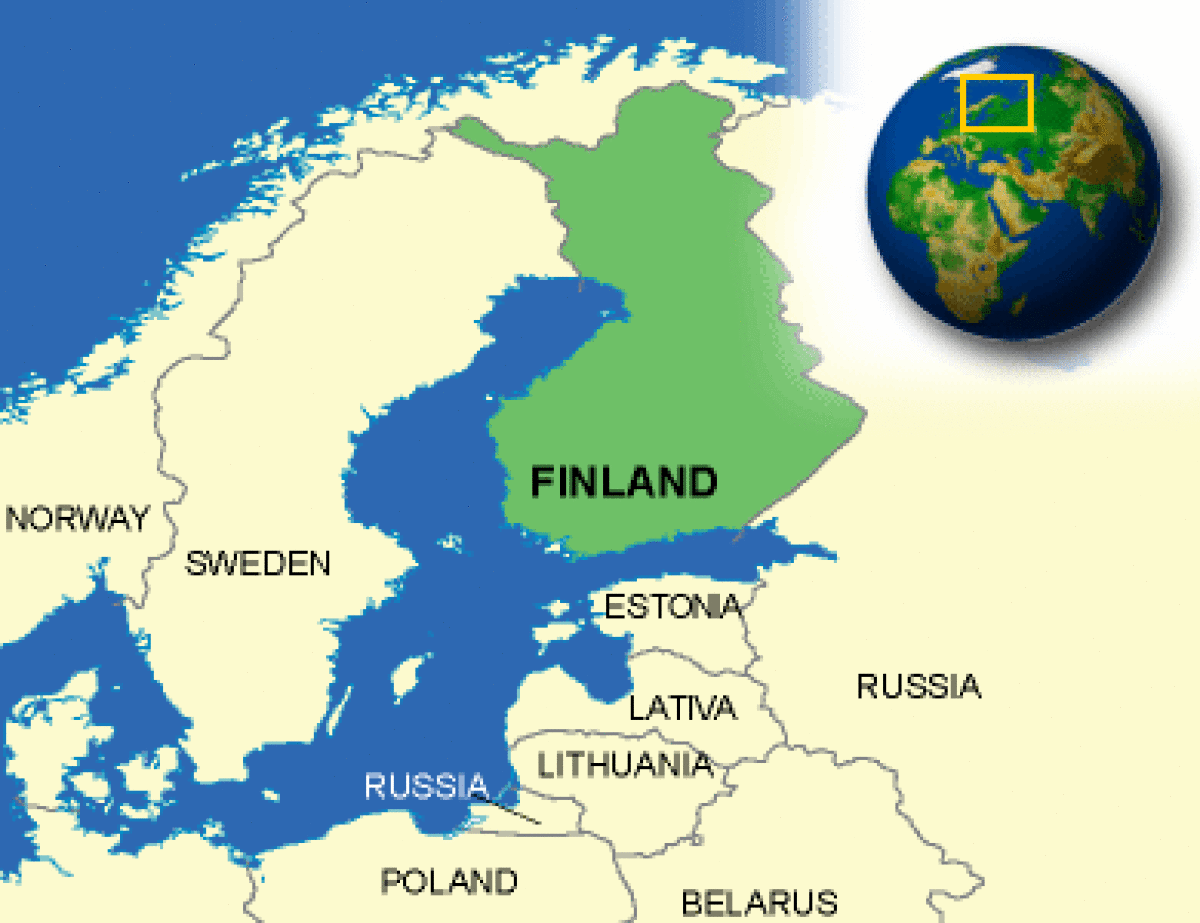
Geographical details of Finland
Finland, country located in
northern Europe. Finland is one of the world’s most northern and geographically
remote countries and is subject to a severe climate. Nearly two-thirds of
Finland is blanketed by thick woodlands, making it the most densely forested
country in Europe. Finland also forms a symbolic northern border between
western and Eastern Europe: dense wilderness and Russia to the east, the Gulf
of Bothnia and Sweden to the west.

Education system in Finland

Some important facts on Education system of Finland
- · “Education is free of cost and equal to all students” this is the basic principle of education system of Finland.
- · Children go to the school at the age of 7 years for their basic education.
- · 99 % students study in government schools.
- · There are no space for private schools and coaching also.
- · Mid – day meal is provided to the all students.
- · Education system and the quality of education of schools are same whether those are situated in village or in city.
- · A class teacher remains the same from first class to sixth class .The reason behind it is that a class teacher try to maintain a relationship with all students .
- · English language is taught using musical instruments and playing English songs so that it can be easy to learn .
- · Most important part of education system of Finland is that the special attention is paid to those students who are weak in studies. It is the responsibility of school to help those students in those subjects in which they are weak. If they do not recover special extra classes are given to them and teachers from outside are also called so that they can help them to grow their level up.
- · Many foreign languages are taught to the students during the period of upper secondary school.
- · Different kinds of games are played by students and these help them to create better understanding .They interact with all students, trust them, learn team building and social qualities.
- · No examination is conducted from 1st std. to 12th std. They go to the next class on the basis of internal assessment.
- · Education system of Finland is completely Governalized.
Education in Finland in nutshell, here is Pdf link of this article.
another superb clarification of Education system in Finland.
reasons for behind the success of Finland education system.
Why Finland famous for education???
Pasi Sahlberg is Finnish educator, author and scholar. He is experienced in classroom teaching, training teachers and leaders, coaching schools and advising education policy-makers around the world. Pasi is an international speaker and author who has given more than 400 keynote speeches and published over 100 articles, chapters and books on education.
When he questioned about success of education in Finland.
he speaks on education system of Finland
Comparison with American education system
Here are a few things about the Finnish education system
and how it compares with the United States:
1. Teacher
Quality
Teacher quality is similar in both countries
–there are good teaching in both Finland and the United States. A pronounced
difference, however, is how the Finnish education system supports teachers to
individually teach and assess students’ intellectual growth in person rather
than through annual standardized tests; this personalization supports each
student to become his or her own personal best, rather than become one of the
many similar “products” in an assembly line – like the current model in the
United States.
2. Problem
Solving
we can observe problem solving in almost every class, every
day in Finland, whereas in the United States there is very little time to
go into depth on any specific topic. A Finnish teacher, Mikko Korhonen,
offered an analogy for his teaching methods: “Teaching is like sailing – I know
where I want to take the students but there are many ways to get there; how we
get there depends upon the questions students ask and what interests them.”
This approach used to occur more frequently in American classrooms until No
Child Left Behind was implemented and preparations for standardized tests
took precedence for classroom instruction. American teachers strive to make
lessons interesting and compelling but the “intent” of the system takes away
much of their freedom and time to do so.
3. Pace
of Instruction
In Finland it's the pace of the learner,
not the pace of the teaching, which determines the progression of curriculum in
a classroom. Finnish teachers are told, in essence, “Here's an objective;
take your students on an [intellectual] journey.” Finnish teachers are
given the time and freedom to work with topics that interest the
students, and teachers are able to challenge their students to solve
problems in an unhurried, relaxed environment.
In the United States, teachers have been given so much
content to teach that the rapid pace often leaves important work unfinished. As
an imperfect analogy for what it’s like to be an American teacher in 2013,
pretend your job is to bake cakes in an assembly line.
